
bundle and weekly content locked
About Weekly content to be unlocked strategy, and bundles with other game developers . A marketing tool , if you will use it wisely you get more exposure.
A #gamedev asked:
"there was at some point a game who wanted to make their release episodic. how this is working for blocking the content, and unlock it once a week 2h of new content, but at the release pays full price, but in reality don't have all the content of the game in that day? what a dev needs to make in steamworks, and how the messaging should be for the gamers about this?"
This has been done before, but it’s also one of the most dangerous release models on Steam if it’s not framed correctly.
HAS THIS BEEN DONE BEFORE?
Yes. Notable examples:
Hitman (2016) - episodic content rollout (commercial backlash at launch)
Kentucky Route Zero - episodic, but price increased over time
Life is Strange - episodic, but episodes clearly defined & priced
Telltale Games – episodic with explicit episode ownership
Early Access games with staged unlocks (safer)
The failures all share one mistake:
Players felt they paid for something that wasn’t there yet without clear framing.
ALL CONTENT SHIPPED, UNLOCKED OVER TIME (SAFE)
How it works
All content is already in the build
You use server-side flags / config / save logic to unlock content weekly
Steam sees it as a complete product
Steamworks setup
One AppID
One build
No DLC required
No updates needed for unlocks
Pros
No refunds issue
No review bombing risk
Steam-compliant
Best for “2h/week unlocks”
Cons
Content technically exists on Day 1 (players could datamine)
This is how most modern “staggered content” games do it.
another option
DLC-BASED EPISODES (RISKY BUT CLEAR)
How it works
Base game
Each episode is a DLC
DLC is set to “Coming Soon”
DLC unlocks weekly
Steamworks setup
Base AppID
Multiple DLC AppIDs
DLC auto-granted if user owns base game
Pros
Very clear ownership
Explicit episode labeling
No ambiguity
Cons
Lots of Steamwork overhead
Each DLC visible = pressure
Risk of “why isn’t it all here?”
Used by:
Telltale
Life is Strange
SHIPPING INCOMPLETE GAME AT FULL PRICE (DON’T)
This is what Hitman 2016 did initially.
Why it failed :
Full price
Content missing
Episodic framing unclear
Players felt tricked
Steam reviews punished this heavily.
Steam players expect:
If it’s full price and not Early Access, the core experience must be complete.
If you ... that expectation:
Refund rate spikes
Reviews focus on “missing content”
Algorithm suppresses you
Even if your plan is good.
The games that survived did three things :
THEY NEVER SAID “ALL CONTENT INCLUDED”
Instead they said:
“Episode 1 launches on Day 1”
“New chapters released weekly”
“This season includes X episodes”
Never imply completeness if it’s staged.
THEY SHOWED A CLEAR STRUCTURE
Good messaging example:
Launch includes Episode 1 (-+6 hours)
Episodes 2–5 unlock weekly
All episodes included in purchase
Clarity removes anger.
THEY DID NOT USE “FULL GAME” LANGUAGE
They avoided:
“Full experience available now”
“Complete story”
“Entire campaign included”
Words matter more than mechanics.
Follow:
Ship a complete core game
Gate additional content as “weekly expansions”
Unlock via config / backend
Market as post-launch content, not missing content
This aligns with:
No Man’s Sky
Dead Cells
Hades
Modern live-but-not-live-service games
SENTENCE TEMPLATE
The game launches as a complete experience, with additional content unlocking weekly at no extra cost.
That sentence avoids every trap.
SAFE LANGUAGE
“Post-launch content unlocks weekly”
“New missions released over time”
“Ongoing content updates included”
DANGEROUS LANGUAGE
“The full game will be available later”
“Content arrives after purchase”
“Episodes coming soon” (unless DLC-based)
You CANNOT create a bundle that includes games you don’t manage in Steamworks unless the other developers explicitly cooperate and grant access.
There is no way to bundle “external” games unilaterally.
Steam does not allow third-party bundling without consent.
What you must do
Contact the other developer(s)
Agree to create a joint bundle
Each developer must:
Opt their app into the bundle
Approve pricing rules
How it works in Steamworks
One party creates the bundle
Other devs approve participation
Revenue is split automatically by Steam
You do NOT need to manage their app
You DO need their approval
You share the same publisher
or
One publisher manages multiple apps
Then:
Publisher can create and manage the bundle
This is common for:
Label collections
Curated series
Studio showcases
What YOU should do (step-by-step)
Step 1 . Contact the devs
Pitch:
Why the bundle helps them
Expected uplift
Discount structure
Timing (sale / Next Fest / theme event)
Step 2 . Agree on terms
Revenue split (Steam handles automatically)
Discount % (usually uniform)
Duration
Step 3 . Create the bundle
One party creates it in Steamworks
Invite the other apps
They approve
Step 4 . Promote via Events
Cross-post Steam Events
Link the bundle everywhere
3–6 games max (conversion drops after that)
Same genre or audience
Similar price range
Clear theme (“Tactical FPS”, “Solo Dev Survival”, etc.)
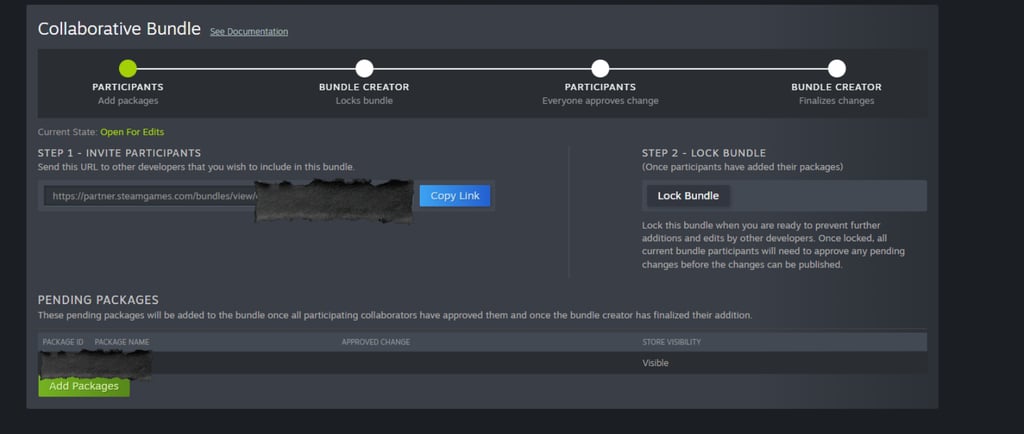
You invite other studios directly from Steamworks, and they approve inside their own Steamworks.
Valve only reviews the bundle after all parties approve.
ONE STUDIO CREATES THE BUNDLE
Only one Steamworks partner does this.
In Steamworks:
Go to Bundles
Click Create New Bundle
Choose bundle type:
“Complete the Set” (most common)
or “Package” (rare, more complex)
Give it:
Internal name
Public name (can change later)
ADD EXTERNAL GAMES (OTHER STUDIOS)
Inside the bundle editor:
Click Add App
Enter the AppID of the other studio’s game
Add all desired games
⚠️ You do not need to manage their app
⚠️ You cannot force-add them
Steam now marks those apps as:
“Pending approval from partner”
STEAM NOTIFIES THE OTHER STUDIOS
This part is automatic.
What happens:
Steam sends a Steamworks notification to the other partner
The other studio sees:
Bundle name
Included apps
Revenue share
Pricing rules
There is no link you send . Steam handles this internally.
OTHER STUDIOS APPROVE IN STEAMWORKS
The other studio must:
Log into Steamworks
Go to Bundles / Pending approvals
Review the bundle
Click Approve or Reject
They can:
Ask you questions outside Steam
Approve when ready
Reject with no penalty
Nothing goes live until everyone approves.
FINALIZE & SUBMIT
Once all studios approve:
You finalize:
Pricing
Discount rules
Regions
Submit the bundle
Now Valve does a standard review:
Policy compliance
Naming
Pricing sanity
This is usually fast (1–3 business days).
Steam does not introduce you to other devs.
You must:
Contact the other studios first
Explain:
Bundle theme
Timing
Expected benefit
Discount range
Once they say “yes”:
→ you create the bundle and add their AppID.
REVENUE & PRICING (IMPORTANT NOTE)
Steam auto-splits revenue per game price
You cannot manually change revenue shares
Discounts apply uniformly unless negotiated via timing
This keeps things fair and transparent.
Before creating the bundle, send them something like:
We’re putting together a [theme] bundle for [timing].
If you’re interested, we’ll add your AppID and Steam will notify you to approve inside Steamworks.
No extra setup needed on your side.
That’s enough.
QUICK DECISION TABLE
Scenario Use
Multi-dev indie bundle ✅ Complete the Set
Themed genre bundle ✅ Complete the Set
Game + DLC 🟡 Package
Franchise / GOTY 🟡 Package
Festival collab ✅ Complete the Set
PACKAGE (Static bundle) use ONLY in specific cases
What it is
Fixed bundle
User buys everything, even if they already own parts
Old-school bundle behavior
When it makes sense
✔ Franchise bundles
✔ GOTY editions
✔ Deluxe editions
✔ “Game + DLC + Soundtrack”
✔ Single-publisher collections
Why it’s risky for multi-dev
Users hate rebuying games
High refund rates
Lower conversion
Other devs may refuse participation
📌 Avoid for cross-studio bundles.
COMMON BUNDLE MISTAKES
These are the mistakes that kill bundles silently.
Too many games
Ideal: 3–6 games
Bad: 8–12 games
Why:
Price looks overwhelming
Decision fatigue
Conversion drops sharply
Mixed audiences
Do NOT mix:
Hardcore + casual
Single-player + PvP-only
Horror + cozy
Early Access + finished games (usually)
Steam’s algorithm struggles to place the bundle.
Uneven price/value
If one game is:
$30
and others are:
$5–10
It creates:
Perceived unfairness
Dev resentment
Buyer hesitation
Try to keep prices within 2× range.
No clear theme
Bad bundle names:
“Awesome Indie Bundle”
“Developer Friends Pack”
Good bundle names:
“Tactical FPS Collection”
“Neon Action Shooters”
Theme clarity = conversion.
Not coordinating sales timing
If one dev:
forgets to discount
delays approval
changes pricing last minute
→ bundle breaks or underperforms.
Always agree on:
discount %
start/end date
communication plan
Expecting Valve to promote it
Valve does not promote your bundle automatically.
You must:
Post Steam Events
Cross-promote
Coordinate announcements
get one key for the whole bundle, and that key activates all games
Single-publisher packages
Retail box products
Old legacy packages
Internal Valve bundles
In those cases:
One key activates a Package
All apps inside are granted
Up to date and marketing tips
Follow me
send me an email
complete the form
contact@devlandmarketing.com
© All rights reserved to Dev Land Marketing